The Hindu Wedding Ceremony: Every Ritual Explained
A ritual-by-ritual guide to the Hindu wedding ceremony: baraat, varmala, kanyadaan, agni, pheras, sindoor and vidaai, with BC timing and mandap notes.

Priya Iyer
South Asian Weddings Editor
11 min read
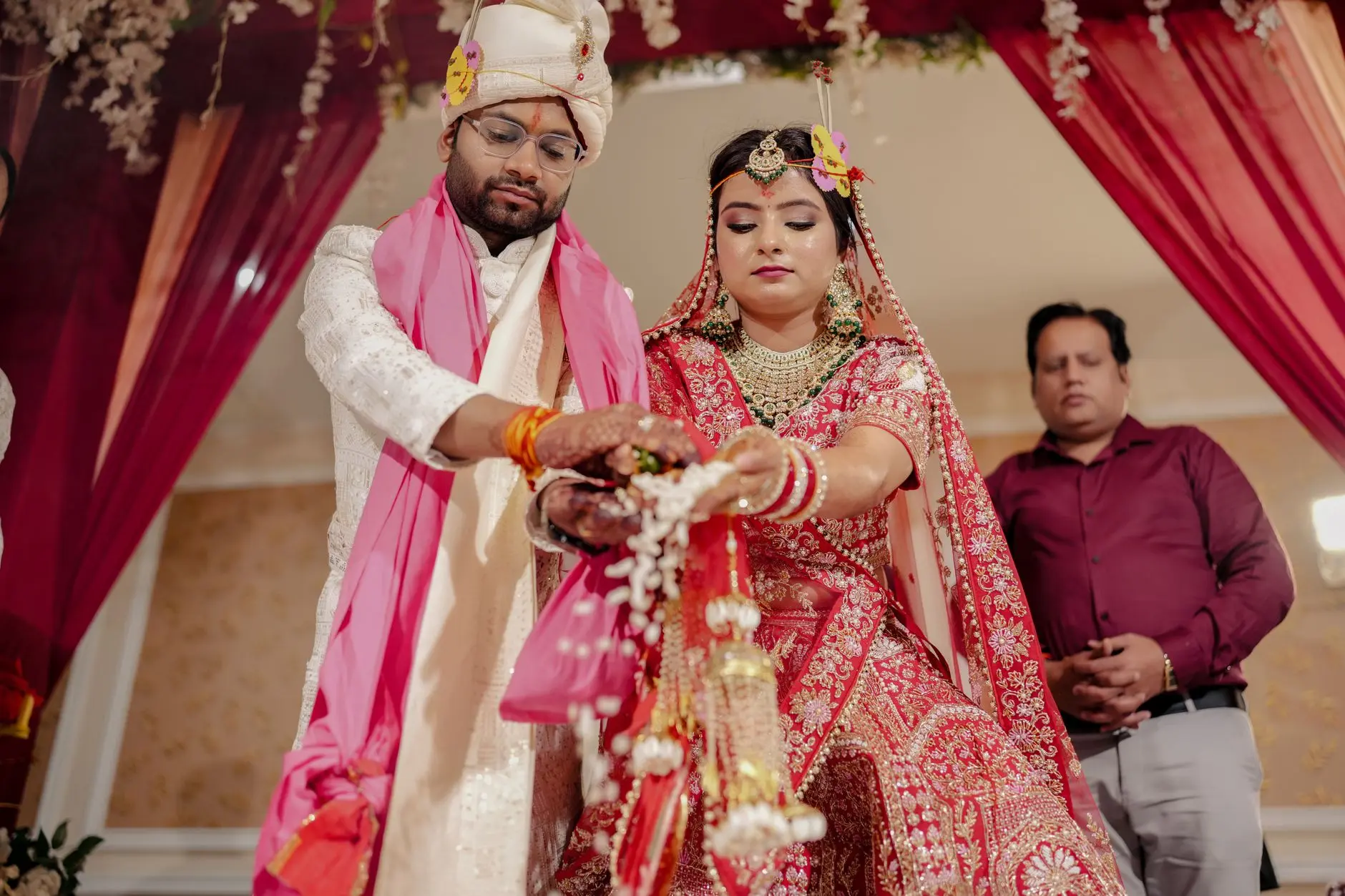
A Hindu wedding ceremony, known in Sanskrit as vivaah, is built from a sequence of rituals performed in front of a sacred fire, with a priest guiding the couple and their families through vows that date back thousands of years. It is not a single script followed the same way everywhere. A Gujarati ceremony, a Tamil ceremony and a Punjabi ceremony share a common backbone, agni as witness, phera as commitment, but differ in sequence, language and small details that matter a great deal to the families performing them.
This guide walks through the order most families in British Columbia will recognize: the baraat arrival, varmala, kanyadaan, the mangal pheras and saptapadi around the fire, sindoor and mangalsutra, and vidaai. Along the way it flags where regional and family practice diverges, because flattening those differences does a disservice to the people actually planning the day.
Across Metro Vancouver, the Fraser Valley and the Okanagan, these ceremonies happen in banquet halls, backyards, community centres and occasionally outdoors in summer, each with its own practical demands on timing, fire safety and seating. The sections below cover both the ritual meaning and the logistics a host actually has to plan around.
What Is a Hindu Wedding Ceremony?
A Hindu wedding ceremony is a samskara, a sacrament marking a significant life transition, performed under a four-pillar canopy called a mandap in front of a sacred fire, agni, which acts as a divine witness to the vows exchanged. A priest, called a pandit or purohit, leads the couple and their immediate families through a series of Sanskrit verses and ritual actions, many rooted in Vedic tradition and adapted over centuries by region and community.
The ceremony is understood as a union of two families as much as two individuals, which is why so many rituals give parents, siblings and extended relatives a direct role instead of leaving them as spectators. The core elements, fire, garlands, circling, vows and farewell, appear in nearly every Hindu wedding ceremony in some form, even as the order, number of repetitions and surrounding customs shift from one community to the next.
What Is the Order of Events, From Baraat to Vidaai?
Most Hindu wedding ceremonies in BC follow a recognizable sequence, though families compress or reorder parts of it depending on venue time and priest availability.
- Baraat: the groom's procession arrives at the venue, often with dhol drumming and dancing, and is formally welcomed by the bride's family.
- Varmala (or jaimala): the couple exchanges flower garlands, a public gesture of acceptance that is often lighthearted, with friends lifting the couple to make the garlanding playfully difficult.
- Kanyadaan: the bride's parents formally entrust her hand to the groom.
- Mangal pheras and saptapadi: the couple circles the sacred fire and takes seven steps and vows.
- Sindoor and mangalsutra: the groom marks the bride as married according to regional custom.
- Vidaai: the bride says farewell to her parental home.
The baraat itself has grown into its own event in many Punjabi and North Indian weddings, with music, dancing and a formal greeting ritual before the couple ever reaches the mandap. For a closer look at how that procession is organized and who takes part, see this guide to the baraat procession.
What Happens During Kanyadaan?
Kanyadaan literally means "giving the daughter" and is one of the most emotional moments of a Hindu wedding ceremony for most families. The bride's father, sometimes joined by her mother, places her hand into the groom's hand, often with water poured over their joined palms, symbolizing the formal entrusting of her welfare to her new husband and his family.
In South Indian ceremonies the equivalent ritual, kanyadanam, is performed with similar intent but different accompanying verses and is frequently followed by the oonjal, a swing ceremony unique to Tamil and some Telugu weddings. Some modern families, particularly where both parents want to participate equally or where the language of "giving away" feels dated, adapt the wording or involve both sets of parents in blessing the couple rather than performing the ritual exactly as written in older texts. Families mapping out the cost and order of every ceremony leading up to the wedding day may find this ceremony-by-ceremony cost and timeline guide useful for planning.
What Do the Agni, Mangal Pheras and Saptapadi Mean?
Agni, the sacred fire, sits at the centre of the mandap and functions as the witness to every vow taken during the ceremony. The couple circles this fire during the mangal pheras, a ritual performed four times in many North Indian traditions (representing dharma, artha, kama and moksha, the four aims of life) or seven times in other communities, where the circling and the saptapadi are combined into one continuous rite.
Saptapadi, the seven steps, is the heart of the ceremony in nearly every regional tradition. With each step taken together around or beside the fire, the couple recites a vow: for nourishment, strength, prosperity, wisdom, progeny, health and lifelong companionship. In many communities, the marriage is considered complete, spiritually and in some cases legally, once the seventh step is taken. South Indian ceremonies generally include saptapadi as well, though it is often preceded by rituals such as the tying of the thali or mangalsutra at a precisely calculated moment, muhurtham, that the whole gathering waits for together.
What Do Sindoor and Mangalsutra Signify?
In North Indian and many Hindi-speaking traditions, the groom applies sindoor, a red or vermillion powder, to the parting of the bride's hair immediately after the pheras, marking her as married. He then ties or places a mangalsutra, a necklace typically strung with black and gold beads, around her neck. Both are worn afterward as everyday signs of marital status in many communities, though how visibly and for how long varies by family, generation and personal preference.
South Indian communities place more emphasis on the thali or mangalsutra tying than on sindoor, and the moment is often the ritual high point that guests watch for most closely, timed to an exact auspicious minute determined by the priest. Maharashtrian, Bengali and Gujarati ceremonies each have their own variations on when and how these symbols are presented. None of this is universal, and increasingly some couples choose to adapt, simplify or skip elements of this part of the ceremony based on their own beliefs about what the symbols should mean going forward.
How Does the Ceremony Vary by Region?
Hindu wedding ceremonies are not uniform across India, and families in BC often blend practices from their specific region or add customs their parents or grandparents brought with them.
- North Indian and Punjabi ceremonies typically feature four mangal pheras, a baraat with dhol, and sindoor application as a central visual moment.
- South Indian ceremonies (Tamil, Telugu, Kannada, Malayali) often include the oonjal swing ritual, a more detailed muhurtham for the mangalsutra, and seven pheras combined with saptapadi.
- Gujarati ceremonies frequently include a garba or raas night before the wedding and a ritual called mangal phera paired with distinct pre-ceremony customs.
- Bengali ceremonies include shubho drishti, the couple's first ceremonial glimpse of one another, and saat paak, seven circles the bride makes around the groom rather than the couple circling the fire together.
- Marathi ceremonies centre on the antarpat, a cloth held between the couple until the auspicious moment, then lowered for the mangalsutra tying.
Families planning a wedding that blends regional traditions, or blends these customs with another faith or culture, may also want to look at this guide to cross-cultural wedding styling for ideas on balancing two sets of ritual needs in one event.
How Long Does a Hindu Wedding Ceremony Take, and When Is It Scheduled?
The ceremony itself, from baraat arrival through vidaai, typically runs two to four hours depending on how many rituals are included and how large the families are. Much of that time is shaped by the muhurat, an auspicious window of time calculated by the priest using a lunisolar calendar, which can fall early in the morning, late at night or at an hour that has little to do with venue convenience.
In BC, families often work closely with their pandit and their venue to find a muhurat that fits within a realistic booking window, and some choose to perform a shortened version of the core rituals at the calculated time while saving the larger reception celebration for later in the day. The wedding ceremony itself is usually just one day within a longer sequence of events, including haldi and mehndi in the days before. For families mapping that full timeline, these guides cover the haldi ceremony and multi-day desi wedding planning in detail.
What Does the Mandap Need?
The mandap is the four-pillar canopy under which the ceremony takes place, traditionally understood as a symbol of the new home the couple is building together. It needs four posts and a canopy top, open enough on the sides that family and guests seated around it can witness the rituals rather than watching from a distance. Inside, there needs to be seating for the couple and the officiating priest, positioned around the space for the agni, and often additional seating or low stools for parents who take part directly in kanyadaan and other rituals.
Many BC venues, particularly indoor halls and tented outdoor spaces, restrict open flame, which means families need to confirm early whether a controlled ceremonial fire is permitted or whether a priest-approved alternative, such as a smaller contained flame or an LED substitute, will be used instead. Floral and fabric draping on the mandap structure, flanking florals or pillars at the entrance, and enough clearance for the baraat procession to approach the mandap are all practical details worth settling with the venue before the day.
Decor and styling for a Hindu wedding ceremony
The mandap is the visual centre of the whole ceremony, so most of the decor budget and attention goes there, with secondary touches at the entrance where the baraat arrives and anywhere guests will be seated to watch. A gold or neutral structure tends to work well because it reads clearly in photos against whatever floral colour palette the family chooses, and it holds up visually whether the ceremony is indoor or set up outdoors for a summer wedding.
The Gold Arch Backdrop is a 7.2-foot gold metal arch that can be styled with florals, fabric draping or greenery to frame the couple at the centre of the mandap or as a secondary arch at the entrance. Flanking it, the Elegant White Wooden Display Plinth, 42" and the shorter Elegant White Wooden Display Plinth, 30" create layered height for floral arrangements on either side of the fire area, and they group well together for a more built-out look. For venues with flame restrictions where an open ceremonial fire is not permitted, the Luxe Cordless LED Table Lamp provides warm ambient light without an open flame, useful near the mandap or along a head table. Parents or the couple often need a place to sit between rituals, and the Ivory Velvet Scalloped Loveseat works well positioned to one side of the mandap for that purpose. OWC Decor, based in Fort Langley, rents these pieces to families across Metro Vancouver, the Fraser Valley and the Okanagan and can help work out what fits a specific mandap footprint. Browse the full collection for more mandap and ceremony styling options.
Frequently Asked Questions
What is the difference between vivaah and shaadi?
Vivaah is the Sanskrit term for the Hindu wedding ceremony itself, the ritual sequence performed in front of the sacred fire. Shaadi is a more general Hindi word for wedding that can refer to the whole event, including the reception and surrounding celebrations, not just the ceremony.
How many pheras are performed in a Hindu wedding ceremony?
Most North Indian and Punjabi ceremonies include four mangal pheras, while many South Indian and other regional traditions combine seven circles with the saptapadi vows. The exact number depends on the family's regional background and the priest's guidance.
Can a Hindu wedding ceremony be held outdoors in BC?
Yes, many families hold the ceremony outdoors in spring and summer, particularly in the Okanagan and parts of the Fraser Valley, as long as the venue allows the mandap setup and any ceremonial fire or its approved alternative. Shade and seating for guests become more important considerations outdoors than they are indoors.
Who officiates a Hindu wedding ceremony?
A pandit or purohit, a Hindu priest trained in the Sanskrit verses and ritual sequence, leads the ceremony. Families typically arrange this themselves, through a priest known to them or their community.
Do all Hindu wedding ceremonies include sindoor?
Sindoor application is most closely associated with North Indian and Hindi-speaking traditions, while South Indian ceremonies place more emphasis on tying the thali or mangalsutra. Many brides wear both customs together depending on family background, and some couples adapt the ritual to their own preferences.
How long before the ceremony does a family need to book a priest and mandap in BC?
Popular wedding dates and auspicious muhurat windows can mean priests and mandap-style rental decor get booked months in advance, especially in peak spring and summer wedding season. Booking six months to a year ahead gives a family more flexibility around both the religious timing and the vendor availability.
Is the Hindu wedding ceremony the same as the reception?
No, the ceremony and the reception are generally treated as separate events, even when they happen on the same day. The ceremony is the ritual portion under the mandap, while the reception that follows is a larger celebration with dinner, dancing and speeches that is not part of the religious rite itself.
Sources and Further Reading
- Encyclopaedia Britannica, "Hinduism": https://www.britannica.com/topic/Hinduism
- BBC Religion and Ethics, "Hindu Rites and Rituals": https://www.bbc.co.uk/religion/religions/hinduism/ritesrituals/
- Pandey, Raj Bali. Hindu Samskaras: Socio-Religious Study of the Hindu Sacraments (Motilal Banarsidass)
- Harvard Divinity School, Pluralism Project, "Hinduism": https://pluralism.org/hinduism