The Korovai: Ukrainian Wedding Bread and Its Traditions
What the korovai wedding bread symbolizes, who bakes and decorates it, the rushnyk, the bread-and-salt welcome, and how BC couples display it today.

Emma Hart
Western Weddings & Budget Editor
11 min read
A Ukrainian wedding reception is rarely complete without a korovai, the tall, braided wedding bread that stands at the centre of the head table and anchors the day's oldest customs. Baked in the days before the wedding and decorated with dough shapes that each carry meaning, the korovai is as much a ritual object as it is something to eat. For Ukrainian and Ukrainian-Canadian families across Metro Vancouver, the Fraser Valley and the Okanagan, the bread remains one of the clearest threads connecting a modern reception back to village customs that predate written record.
This guide explains what the korovai symbolizes, who traditionally bakes it, how it is decorated, and the two customs most closely tied to it: the rushnyk (an embroidered ritual cloth) and the bread-and-salt welcome that greets a couple when they arrive at their reception. It also looks at how families in British Columbia display the korovai today, whether the celebration happens in a parish hall, a rented event space, or a backyard tent.
What is a korovai?
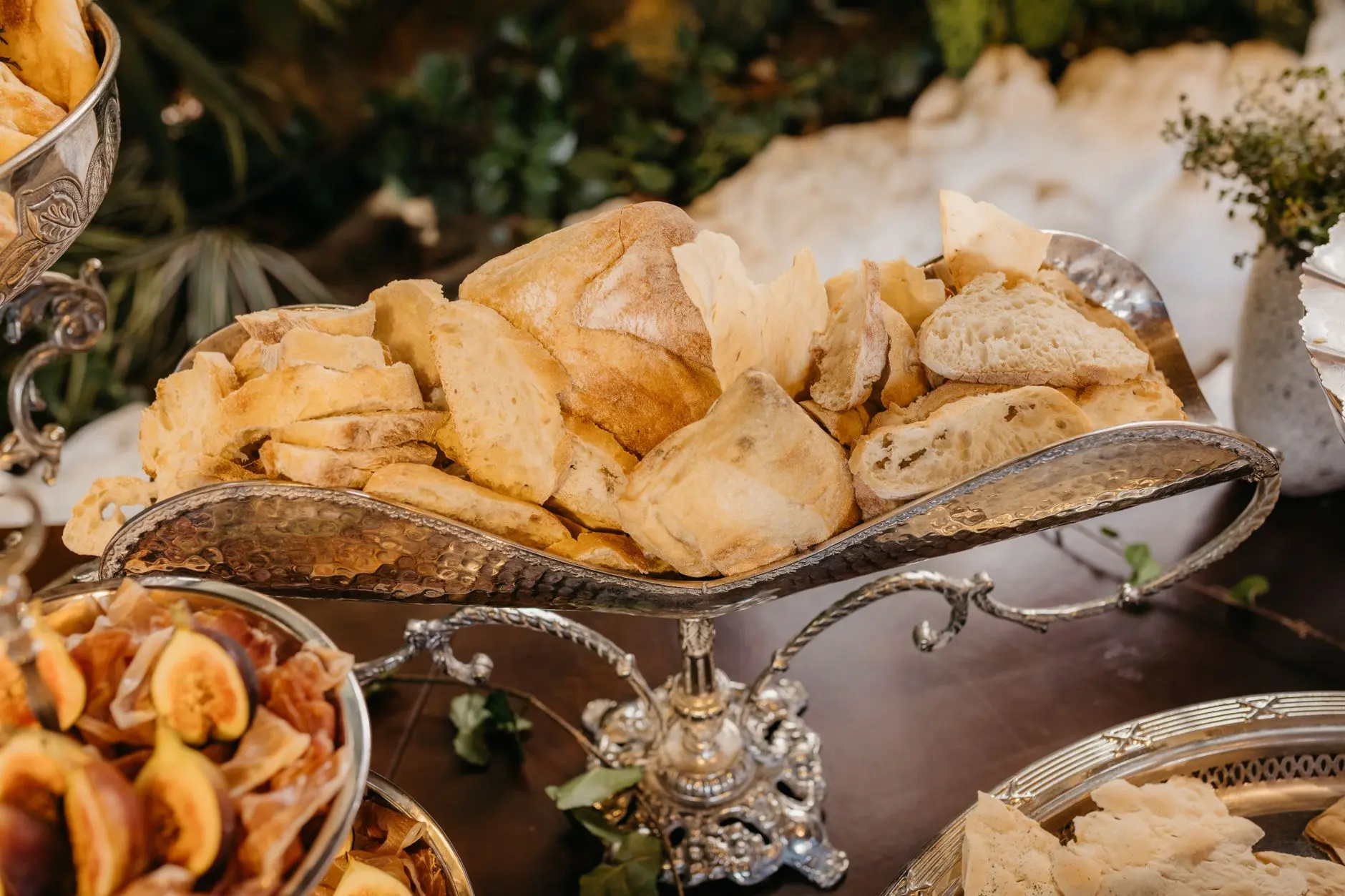
The korovai is a large, round wheat bread, braided and sculpted with dough ornaments. It is a ceremonial loaf baked specifically for a wedding, set apart from the bread a family might bake for everyday meals. It is typically prepared one or two days before the ceremony so it has time to cool and set before it is decorated and displayed. Some families bake a single large korovai to share among all the guests, while others bake one for the bride's side and one for the groom's side, each brought to the reception separately.
The bread is dense and slightly sweet, closer to a rich egg bread than to a sandwich loaf, and it is built to hold its shape under the weight of its decoration. Because it is meant to be seen as much as eaten, bakers often use a plain round base and reserve the detail for a crown of dough shapes pressed and pinched onto the top and sides before the final bake.
What does the korovai symbolize?
Every element of the korovai is chosen for what it represents, and older couples and parents are often the ones who explain the symbolism to younger relatives helping plan the wedding.
- Wheat and the round shape stand for prosperity, abundance and the sun, reflecting the bread's roots in agricultural communities where a good harvest was the measure of a secure future.
- A pair of doves or birds worked into the dough represents the couple, usually placed facing each other at the centre of the loaf.
- Periwinkle (barvinok) leaves symbolize everlasting love and are one of the most common decorative motifs, since the plant stays green through winter.
- Rings or braided bands across the bread stand for the union itself and sometimes for the joining of the two families.
- Pinecones, wheat sheaves or clusters of dough berries represent fertility and a wish for children.
The korovai's roots reach back to pre-Christian harvest and fertility customs in Ukraine, and the bread was later folded into Ukrainian Orthodox and Greek Catholic wedding ceremonies, where a priest may bless the loaf along with the couple. Families who are not part of either church still bake and use a korovai as a cultural custom.
Who bakes the korovai?
Tradition calls for the korovai to be baked by korovainytsi, a small group of married women known for happy, stable marriages. The bride, the groom and both mothers traditionally step back from the baking itself, since the custom calls on women outside the couple's immediate family to do the work. The thinking is straightforward: the women baking the bread are believed to pass some of their own marital luck into the loaf, and a widow or someone in a difficult marriage was traditionally asked not to take part. The work was done with its own songs and small rituals, often over an odd number of women for good luck.
In Canada, many families keep a version of this custom alive even where the full ritual has faded. A close circle of aunts, family friends or church community members often bakes the korovai together, sometimes the week of the wedding, treating the baking session itself as a small pre-wedding gathering. Other families now order a korovai from a Ukrainian bakery or a home baker who specializes in the form, especially in cities with an established Ukrainian-Canadian community, while still asking a few married women in the family to help decorate it by hand.
How is a korovai decorated?
Decoration happens after the bread has baked and cooled, using small pieces of dough shaped by hand and attached with egg wash, then baked again briefly or dried so the ornaments hold. A finished korovai can take several hours of careful, detailed work, which is part of why it is treated as a group effort rather than a solo task.
Common decorative elements include the paired doves at the centre, a ring of periwinkle leaves around the edge, small braided ropes crossing the top, and clusters representing wheat or berries tucked between the larger shapes. Some regional styles add a sprig of real or dough-formed viburnum (kalyna), a berry closely associated with Ukraine itself. Ribbon in red, white or the couple's chosen colours is sometimes woven around the base once the bread is fully baked, and a round plate or decorative stand is used to present it rather than setting it directly on a table linen.
What is the rushnyk and how is it used?
The rushnyk is a long embroidered cloth, usually white linen with red and black or multicoloured cross-stitch patterns. It shows up at several points across a Ukrainian wedding, from the ceremony itself to the reception. Patterns vary by region of Ukraine, with families from Poltava, the Hutsul region or western Ukraine each carrying slightly different motifs passed down through generations of needlework.
During the ceremony, the couple often stands on a rushnyk laid on the floor, a moment meant to symbolize starting married life together on solid, shared ground. A rushnyk may also be used to loosely tie the couple's hands together as a gesture of unity, and the korovai itself is almost always presented on a rushnyk, set on top of the embroidered cloth instead of directly on a bare table or tray. Families that own an heirloom rushnyk, embroidered by a grandmother or great-grandmother, will often use that specific cloth across multiple weddings in the family, which gives the textile as much sentimental weight as the bread it carries.
What happens during the bread-and-salt welcome?
The bread-and-salt welcome (khlib-sil) is the moment when parents greet the newly married couple with the korovai and a small dish of salt, usually right at the start of the reception as the couple arrives at the hall or home. Each parent, or sometimes both sets of parents together, holds the bread out so the couple can each tear off a piece.
The couple dips their piece of bread in the salt and eats it, a gesture tied to an older belief that life together will include both the plain sweetness of bread and the harder, saltier moments, and that a strong marriage means being able to take both. A lighthearted custom sometimes attached to this moment holds that whoever takes the bigger bite, or the smaller pinch of salt, will have the stronger hand in running the household, and guests often laugh and cheer as the couple goes through it. After this welcome, the korovai is usually set at the head table for the rest of the event, with the cutting and serving happening later in the reception.
How do Ukrainian-Canadian couples display the korovai at a reception today?
Across BC's Ukrainian-Canadian communities, from longstanding parish congregations to younger couples planning weddings in Kelowna, Abbotsford or the Lower Mainland, the korovai almost always holds a place of honour at the head table, visible to the whole room instead of being tucked away on a side buffet. Many couples set it on a raised stand or a pedestal so it is visible to the whole room, often alongside the rushnyk it was carried in on.
Some families now treat the korovai as a complement to a contemporary wedding cake: the korovai is used for its ceremonial role in the bread-and-salt welcome and later cut and shared with guests as a blessing, while a separate cake serves dessert. Outdoor and tented summer receptions in the Okanagan and Fraser Valley call for a bit of planning, since a decorated korovai can be heavy and should be kept out of direct sun and away from wind that could disturb delicate dough ornaments before photos are taken. Couples who want the bread featured in formal portraits often schedule a few minutes with it near the start of the reception, before the room fills and before the cutting itself, so the full decoration is visible in photographs.
Decor and styling for a Ukrainian wedding reception
The korovai and rushnyk are naturally the visual centre of a Ukrainian reception's head table, so the styling around them works best when it is simple enough to let the bread and embroidery stand out, without extra colour or pattern competing for attention. A neutral display with a little height, plus warm candlelight, tends to photograph well against the gold and cream tones of the braided dough.
- An Elegant White Wooden Display Plinth, 30" gives the korovai height on the head table without crowding the place settings around it, and its clean white finish stays neutral against the bread's golden crust.
- A White Display Wall with Shelves works well near the entrance for the bread-and-salt welcome, giving parents a steady, visible spot to present the korovai and rushnyk as guests arrive.
- Natural / Cream Cotton Napkins echo the wheat tones of the bread on the surrounding tables without introducing a competing colour.
- Elegant Glass Pillar Candle Holders placed around the display add warm light in the evening without drawing attention away from the bread's dough detailing.
- A Vintage Gold Ornate Mirror behind the head table adds a formal backdrop for photos of the korovai presentation without needing additional signage.
OWC Decor, based in Fort Langley and serving Metro Vancouver, the Fraser Valley and the Okanagan, carries plinths, linens and candle holders that work well for this kind of head table display, and the team can talk through sizing and layout for whatever hall or home you're hosting in. For more general tablescape planning, see the full collection or the wedding centerpiece and tablescape guide. Couples blending Ukrainian customs with a partner's own traditions may also find the cross-cultural wedding styling guide useful for planning two sets of rituals in one reception.
Frequently Asked Questions
Do you eat the korovai, or is it only for display?
It is meant to be eaten, usually cut and shared with guests later in the reception as a kind of blessing bread. Many families serve it alongside the wedding cake, so guests get both a slice of korovai and a piece of cake.
Who is allowed to bake the korovai?
Tradition calls for a small group of married women with stable, happy marriages, known as korovainytsi. The bride, groom and both mothers traditionally step back from the baking itself. Many Ukrainian-Canadian families now also use a bakery that specializes in the form, sometimes with family members helping decorate the finished loaf.
What does it mean if the bride or groom takes the bigger piece during the bread-and-salt welcome?
In the lighthearted version of this custom, taking the larger bite or the smaller pinch of salt is said to predict who will have the stronger hand in running the household. It is treated as a playful moment, and most couples laugh through it along with their guests.
Is the korovai tied to a specific religion?
The korovai's symbolism reaches back to pre-Christian harvest customs that predate any single religious tradition. Many couples also have the bread blessed as part of a church wedding, and families who are not part of a church still bake and use a korovai as a cultural tradition.
What is the difference between a korovai and a rushnyk?
The korovai is the bread itself, while the rushnyk is the embroidered cloth it is presented on and the cloth the couple may stand on or have their hands tied with during the ceremony. The two are almost always used together, but they are distinct objects with separate histories.
Can a korovai be displayed outdoors for a summer BC wedding?
Yes, but it needs to be kept out of direct sun and away from strong wind, since the dough ornaments are delicate and the bread can dry out or shift if it sits in heat for hours. Many couples bring the korovai out for the welcome and photos, then move it to a shaded or indoor spot for the rest of the reception.
Does every Ukrainian wedding have a korovai?
Not every family includes one, and some choose a smaller version or skip the ritual entirely depending on how closely they follow older customs. It remains common enough, though, that most Ukrainian-Canadian receptions in BC include at least some version of the bread and the welcome that goes with it.
Sources and Further Reading
- Internet Encyclopedia of Ukraine, University of Toronto: "Korovai"
- Natalie Kononenko, Ukrainian Minstrels: And the Blind Shall Sing (M.E. Sharpe), for background on Ukrainian ritual song traditions tied to weddings
- Canadian Institute of Ukrainian Studies, University of Alberta
- Encyclopedia Britannica: Ukrainian Orthodox Church